The Project

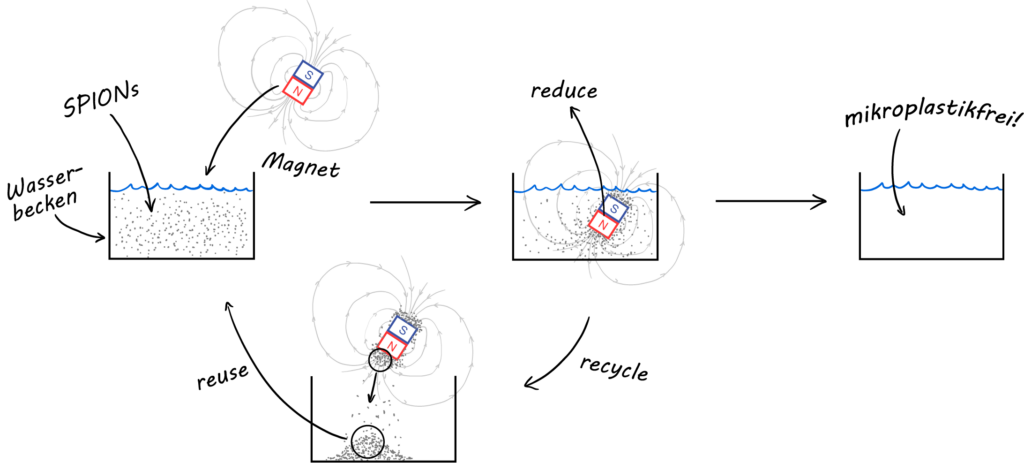
Efficiently and ergonomically removing microplastics from water is the focus of this thesis, microclear, from HTL Rennweg 1030 Vienna.
SPIONs?
The development of this device subsequently aims to generate a commercial application for SPIONs. These are super-paramagnetic iron oxide nanoparticles, a discovery of the Friedrich-Alexander University in Erlangen-Nuremberg, which are both magnetic and, thanks to a special surface coating, capable of binding microplastics.
Since SPIONs have not yet reached the stage of practical application, this thesis uses substitute particles with similar properties to ensure testing as realistically as possible.
How does it work?
Iron oxide particles are removed from the water in two steps.
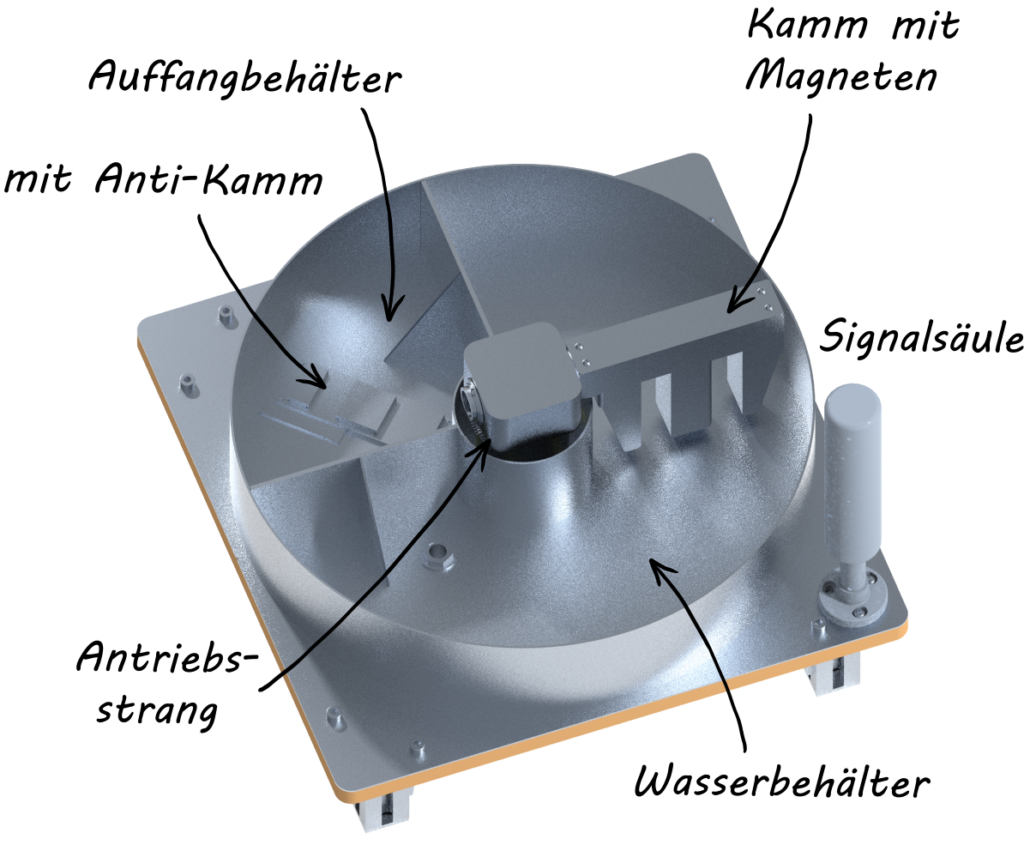
First, the comb passes through a tank filled with water and iron oxide particles. The comb contains three different magnets that are activated in the water tank. This causes the particles to cling to the comb and allow them to be removed from the water.
Once the comb is in the collection basin, the magnets are deactivated, causing the particles to detach from the comb and be attracted to the magnetic anti-comb. The particle-free comb then moves further into the water basin, and the cycle begins again.
The effects of different magnetic fields on such small particles are evaluated using three different types of magnets:
- a commercially available electromagnet, whose field is directed in a specific direction
- a self-wound electromagnet, where the magnetic effect can spread out as desired
- an array of permanent magnets, which are lifted from the comb’s prongs using an additional device